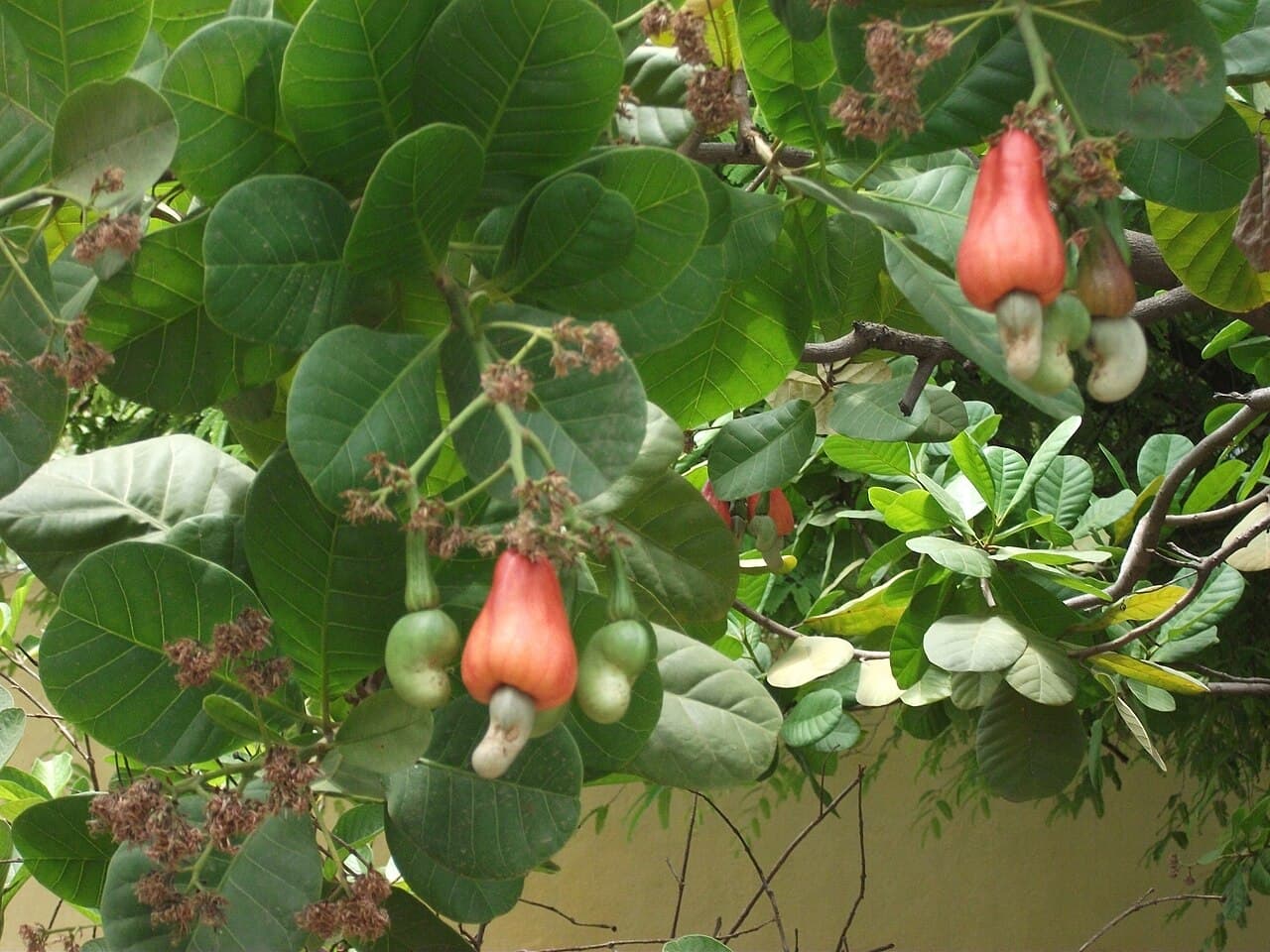
Cashew
Anacardium occidentale
A tropical evergreen tree native to northeastern Brazil, spread by Portuguese traders in the 16th century and now widely cultivated in Nigeria. The cashew nut is eaten as a snack, and the bark, leaves, and seeds are used in traditional medicine, while the nut shell yields an industrial oil (CNSL) used in lubricants and resins.
- Category
- Medicinal
- Found in
- West, Central, East and Southern AfricaPOWO
- Data sources
- NMPPDB, Dr. Duke's, other literature
Local names
Known in 3 languages across 2 regions
Say it in
Yoruba · West Africa
Kasu
West Africa
East Africa
Spot a wrong name, or know another one?Tell us here ↗
Traditional & Common Uses
Important medical disclaimer
The information below is for educational reference only. It does not constitute medical advice. Always consult a qualified healthcare provider.
- General
Bark and leaf extracts traditionally used for diarrhea, dysentery, ulcers, inflammatory conditions, toothaches, and sore throats.
[1] NMPPDB (nmppdb.com.ng)
- General
Cashew nuts shown to reduce inflammation and oxidative stress in a mouse model of colitis.
[2] Siracusa, R. et al. (2020). Nutrients, 12(3), 834.
- General
Leaf and bark extracts shown to have significant antibacterial activity against Staphylococcus aureus and Escherichia coli in lab studies.
[3] Amorim, L.S. et al. (2022). Drug and Chemical Toxicology, 45(6), 2653–2663.
- General
Hexane leaf extract shown to lower blood sugar in diabetic rats, supporting traditional use for managing diabetes.
[4] Tedong, L. et al. (2007). Acute and subchronic toxicity of Anacardium occidentale Linn (Anacardiaceae) leaves hexane extract in mice. African Journal of Traditional, Complementary and Alternative Medicines, 4(2), 140–147.
- General
Ethanolic leaf extract shown to improve sexual function and raise testosterone levels in stress-exposed male rats.
[5] Wattanathorn, J. et al. (2019). BioMed Research International, 2019, 1459141.
- Ghana
Used in Senegal, Guinea and Ghana to remove warts.
[6] Hartwell, J.L. (1967–71). Plants Used Against Cancer: A Survey. Lloydia 30–34 — via Duke's Ethnobotanical Database
Known Phytochemicals
Cautions & Contraindications
- highSignificant risk documented in literature
- moderatePotential risk; caution advised
- lowMinimal risk under normal conditions
- high
Cashew nuts are a common food allergen and can cause reactions ranging from mild symptoms to severe anaphylaxis in sensitive individuals.
[8] Wikipedia: Cashew, as cited via NMPPDB (nmppdb.com.ng) — a lower-reliability source; worth confirming with a medical reference
- moderate
The nut shell contains anacardic acid and cardol, caustic compounds (related to those in poison ivy) that can cause contact dermatitis, so raw shells need careful processing before the nut is safe to handle and eat.
[4] Tedong, L. et al. (2007). Acute and subchronic toxicity of Anacardium occidentale Linn (Anacardiaceae) leaves hexane extract in mice. African Journal of Traditional, Complementary and Alternative Medicines, 4(2), 140–147.
- low
In mice, high doses of leaf extract (10–14 g/kg body weight) over a prolonged period caused reduced food intake, weight loss, and changes to liver and kidney tissue.
[4] Tedong, L. et al. (2007). Acute and subchronic toxicity of Anacardium occidentale Linn (Anacardiaceae) leaves hexane extract in mice. African Journal of Traditional, Complementary and Alternative Medicines, 4(2), 140–147.
Sources & Citations
- 1NMPPDB (nmppdb.com.ng)
- 2Siracusa, R. et al. (2020). Nutrients, 12(3), 834.
- 3Amorim, L.S. et al. (2022). Drug and Chemical Toxicology, 45(6), 2653–2663.
- 4Tedong, L. et al. (2007). Acute and subchronic toxicity of Anacardium occidentale Linn (Anacardiaceae) leaves hexane extract in mice. African Journal of Traditional, Complementary and Alternative Medicines, 4(2), 140–147.
- 5Wattanathorn, J. et al. (2019). BioMed Research International, 2019, 1459141.
- 6Hartwell, J.L. (1967–71). Plants Used Against Cancer: A Survey. Lloydia 30–34 — via Duke's Ethnobotanical Database
- 7Wikipedia: Anacardic acids, as cited via NMPPDB; toxicity per Tedong, L. et al. (2007). Acute and subchronic toxicity of Anacardium occidentale Linn (Anacardiaceae) leaves hexane extract in mice. African Journal of Traditional, Complementary and Alternative Medicines, 4(2), 140–147.
- 8Wikipedia: Cashew, as cited via NMPPDB (nmppdb.com.ng) — a lower-reliability source; worth confirming with a medical reference
- 9Orwa et al. (2009), Agroforestree Database 4.0, World Agroforestry: Anacardium occidentale