Kola nut
Cola nitida
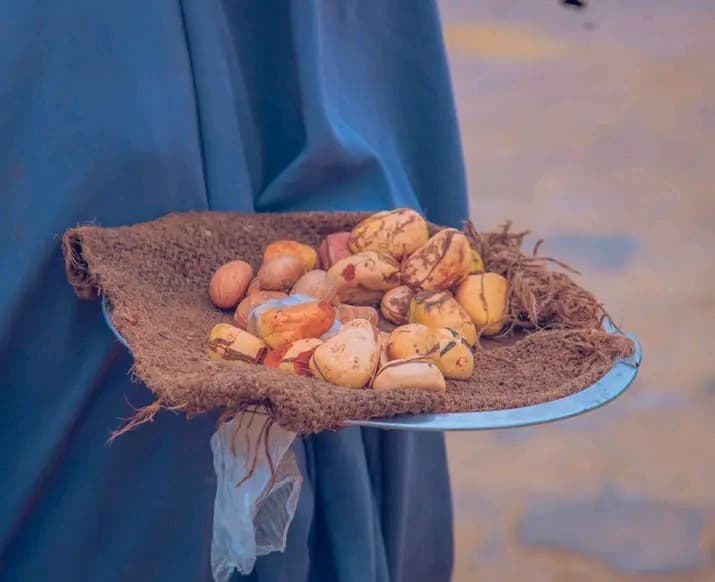
An evergreen tree native to the West African rainforests, closely related to the cacao tree. Its seeds ('kola nuts') are chewed fresh as a stimulant and are deeply significant culturally across Nigeria — offered to guests, used in traditional ceremonies, and referenced in Yoruba divination and Igbo hospitality customs.
- Categories
- Medicinal, Stimulant
- Found in
- West, Central and East AfricaPOWO
- Data sources
- Published literature
Local names
Known in 5 languages
Say it in
Yoruba · West Africa
Obi
West Africa
Spot a wrong name, or know another one?Tell us here ↗
Traditional & Common Uses
Important medical disclaimer
The information below is for educational reference only. It does not constitute medical advice. Always consult a qualified healthcare provider.
- General
Chewed as a stimulant to counteract fatigue, overstrain, and low mood.
[1] World Agroforestry Centre, Cola nitida species database (apps.worldagroforestry.org)
- General
Used to treat diarrhoea and dysentery, and to prevent vomiting during high fever.
[1] World Agroforestry Centre, Cola nitida species database (apps.worldagroforestry.org)
- General
Bark infusion combined with ginger and pepper, taken to treat stomach ulcers.
[1] World Agroforestry Centre, Cola nitida species database (apps.worldagroforestry.org)
- General
Crushed nuts boiled with Morinda lucida leaves, taken to treat piles (hemorrhoids).
[1] World Agroforestry Centre, Cola nitida species database (apps.worldagroforestry.org)
Known Phytochemicals
Cautions & Contraindications
- lowMinimal risk under normal conditions
- low
Contains natural caffeine and theobromine; the same general precautions around caffeine intake (e.g. during pregnancy, or with heart conditions) apply as with other caffeinated foods and beverages.
[4] Burdock, G.A., Carabin, I.G., & Crincoli, C.M. (2009). Safety assessment of kola nut extract as a food ingredient. Food and Chemical Toxicology, 47, 1725–1732.
Sources & Citations
- 1World Agroforestry Centre, Cola nitida species database (apps.worldagroforestry.org)
- 2Burdock, G.A., Carabin, I.G., & Crincoli, C.M. (2009). Food and Chemical Toxicology, 47, 1725–1732.
- 3Knebel & Higler, as cited in kola nut phytochemistry reviews (e.g. Journal of Exploratory Research in Pharmacology, 2017)
- 4Burdock, G.A., Carabin, I.G., & Crincoli, C.M. (2009). Safety assessment of kola nut extract as a food ingredient. Food and Chemical Toxicology, 47, 1725–1732.
- 5Akan (Twi) Dictionary, akandictionary.com: Bese (kola nut)
- 6Orwa et al. (2009), Agroforestree Database 4.0, World Agroforestry: Cola nitida