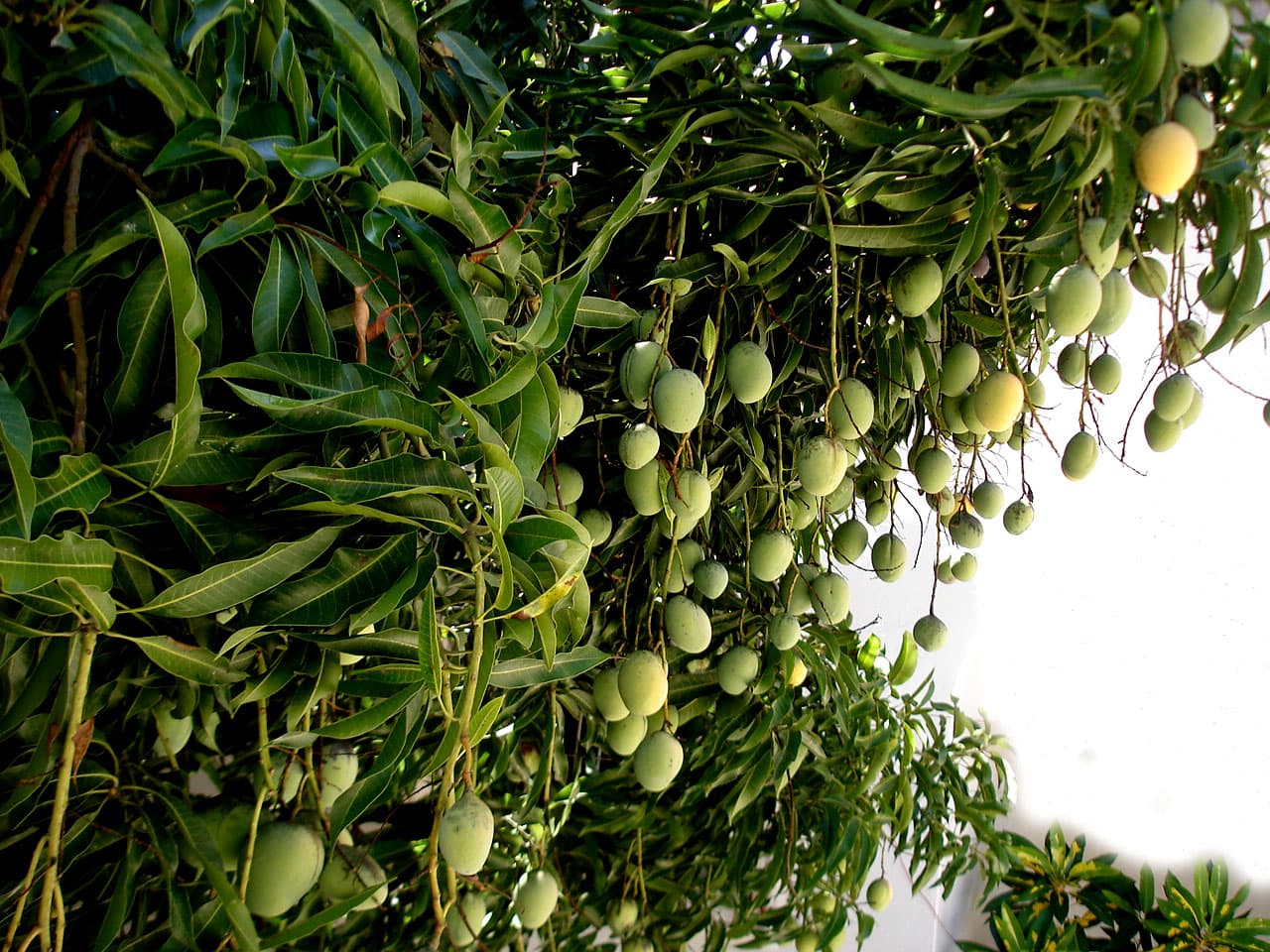
Mango
Mangifera indica
A large evergreen tree, native to South and Southeast Asia and one of the world's most widely grown tropical fruits, with Nigeria among the top producing countries. Beyond the fruit, the bark and leaves have a long history in Ayurvedic and other traditional medicine systems, centered on a signature compound called mangiferin.
- Category
- Medicinal
- Found in
- Across AfricaPOWO
- Data sources
- Dr. Duke's, other literature
Local names
Known in 5 languages across 2 regions
Say it in
Yoruba · West Africa
Mangoro
West Africa
East Africa
Spot a wrong name, or know another one?Tell us here ↗
Traditional & Common Uses
Important medical disclaimer
The information below is for educational reference only. It does not constitute medical advice. Always consult a qualified healthcare provider.
- India
Leaf and bark decoctions traditionally used for diarrhea and dysentery, reported across many countries including China, India, Mexico, and Trinidad.
[1] USDA Dr. Duke's Phytochemical and Ethnobotanical Database (phytochem.nal.usda.gov), Mangifera indica entry
- General
Used as a traditional dewormer (vermifuge) in several regions, including China, Haiti, Mexico, and Turkey.
[1] USDA Dr. Duke's Phytochemical and Ethnobotanical Database (phytochem.nal.usda.gov), Mangifera indica entry
- General
Used in Ayurvedic and other traditional medicine for fever.
[2] Shah, K.A., Patel, M.B., Patel, R.J., & Parmar, P.K. (2010). Mangifera Indica (Mango). Pharmacognosy Reviews, 4(7), 42–48.
- General
Bark and leaves, largely through the compound mangiferin, studied for antidiabetic, antioxidant, anti-inflammatory, hepatoprotective, and antimicrobial activity.
[3] Wauthoz, N. et al. (2007). Ethnopharmacology of Mangifera indica L. bark and its main C-glucosylxanthone, mangiferin. International Journal of Biomedical and Pharmaceutical Sciences.
- General
Used traditionally for piles (hemorrhoids) in China and Malaya, and for hypertension in Trinidad and Curacao.
[1] USDA Dr. Duke's Phytochemical and Ethnobotanical Database (phytochem.nal.usda.gov), Mangifera indica entry
Known Phytochemicals
Cautions & Contraindications
- lowMinimal risk under normal conditions
- low
Most of mango's medicinal properties have been studied in lab and animal settings rather than human clinical trials, so dosing and safety for therapeutic (non-culinary) use are not well established.
[2] Shah, K.A., Patel, M.B., Patel, R.J., & Parmar, P.K. (2010). Mangifera Indica (Mango). Pharmacognosy Reviews, 4(7), 42–48.
Sources & Citations
- 1USDA Dr. Duke's Phytochemical and Ethnobotanical Database (phytochem.nal.usda.gov), Mangifera indica entry
- 2Shah, K.A., Patel, M.B., Patel, R.J., & Parmar, P.K. (2010). Mangifera Indica (Mango). Pharmacognosy Reviews, 4(7), 42–48.
- 3Wauthoz, N. et al. (2007). Ethnopharmacology of Mangifera indica L. bark and its main C-glucosylxanthone, mangiferin. International Journal of Biomedical and Pharmaceutical Sciences.
- 4Orwa et al. (2009), Agroforestree Database 4.0, World Agroforestry: Mangifera indica
- 5KNUST Tree Trail, Kwame Nkrumah University of Science and Technology: Mangifera indica (Twi)