Pawpaw
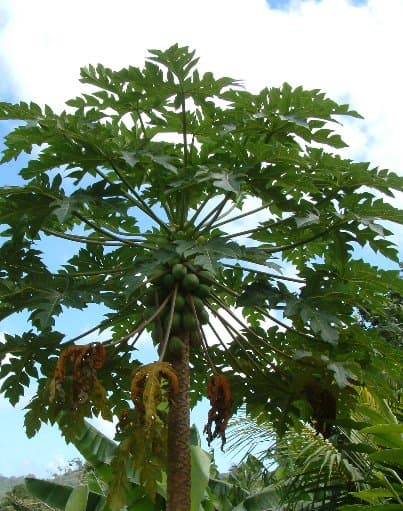
Carica papaya
A fast-growing tropical fruit tree that originated in Central America and is now grown across Africa and Asia. The ripe fruit is eaten fresh, while the leaves, seeds, and latex have long been used in traditional medicine.
- Category
- Medicinal
- Found in
- West, Central and East AfricaPOWO
- Data sources
- Dr. Duke's, other literature
Local names
Known in 5 languages across 2 regions
Say it in
Yoruba · West Africa
Ibepe
West Africa
East Africa
Spot a wrong name, or know another one?Tell us here ↗
Traditional & Common Uses
Important medical disclaimer
The information below is for educational reference only. It does not constitute medical advice. Always consult a qualified healthcare provider.
- General
Used in many parts of the world (including Haiti, Malaya, Panama, Samoa, and Turkey) as a dewormer.
[1] USDA Dr. Duke's Phytochemical and Ethnobotanical Database (phytochem.nal.usda.gov), Carica papaya entry (underlying source references not retrieved)
- South Africa
Applied to warts and corns in several regions (including Indonesia, Jamaica, Peru, South Africa, Sri Lanka, India, and the Philippines).
[1] USDA Dr. Duke's Phytochemical and Ethnobotanical Database (phytochem.nal.usda.gov), Carica papaya entry (underlying source references not retrieved)
- General
Used as a digestive aid (reported in China, the Dominican Republic, Panama, and Turkey).
[1] USDA Dr. Duke's Phytochemical and Ethnobotanical Database (phytochem.nal.usda.gov), Carica papaya entry (underlying source references not retrieved)
- Nigeria
Leaf extract showed antisickling activity in a Nigerian lab study, relevant to interest in papaya for sickle-cell care.
[2] Imaga, N.O., Gbenle, G.O., Okochi, V.I., Akanbi, S.O., Edeoghon, S.O., Oigbochie, V., Kehinde, M.O., & Bamiro, S.B. (2009). Antisickling property of Carica papaya leaf extract. African Journal of Biochemistry Research, 3(4). Also listed among papaya's studied activities in Kaur, M., Talniya, N.C., Sahrawat, S., Kumar, A., & Stashenko, E.E. (2019). Ethnomedicinal uses, phytochemistry and pharmacology of Carica papaya plant: a compendious review. Mini-Reviews in Organic Chemistry, 16(5), 463–480. doi:10.2174/1570193X15666180816110733
- General
Reviews report antioxidant, antiulcer, antibacterial, wound-healing, and anti-inflammatory activity in lab and animal studies.
[3] Kaur, M., Talniya, N.C., Sahrawat, S., Kumar, A., & Stashenko, E.E. (2019). Ethnomedicinal uses, phytochemistry and pharmacology of Carica papaya plant: a compendious review. Mini-Reviews in Organic Chemistry, 16(5), 463–480. doi:10.2174/1570193X15666180816110733
- Madagascar
Used in Madagascar to remove corns.
[4] Hartwell, J.L. (1967–71). Plants Used Against Cancer: A Survey. Lloydia 30–34 — via Duke's Ethnobotanical Database
- South Africa
Used in South Africa to remove warts.
[4] Hartwell, J.L. (1967–71). Plants Used Against Cancer: A Survey. Lloydia 30–34 — via Duke's Ethnobotanical Database
Known Phytochemicals
Cautions & Contraindications
- highSignificant risk documented in literature
- lowMinimal risk under normal conditions
- high
Traditionally used in some regions (Java, Panama, Turkey) as an abortifacient and to bring on menstruation, so medicinal use is best avoided during pregnancy.
[1] USDA Dr. Duke's Phytochemical and Ethnobotanical Database (phytochem.nal.usda.gov), Carica papaya entry (underlying source references not retrieved)
- low
Reviews note that dosage, mechanisms, and safety of medicinal papaya preparations still need proper study.
[5] Khatun, M.A., Akter, T., & Chowdhury, A.R. (2026). Traditional uses, phytoconstituents and pharmacological activities of Carica papaya L.: a comprehensive review. Dhaka University Journal of Pharmaceutical Sciences, 25(1), 81–91.
Sources & Citations
- 1USDA Dr. Duke's Phytochemical and Ethnobotanical Database (phytochem.nal.usda.gov), Carica papaya entry (underlying source references not retrieved)
- 2Imaga, N.O., Gbenle, G.O., Okochi, V.I., Akanbi, S.O., Edeoghon, S.O., Oigbochie, V., Kehinde, M.O., & Bamiro, S.B. (2009). Antisickling property of Carica papaya leaf extract. African Journal of Biochemistry Research, 3(4). Also listed among papaya's studied activities in Kaur, M., Talniya, N.C., Sahrawat, S., Kumar, A., & Stashenko, E.E. (2019). Ethnomedicinal uses, phytochemistry and pharmacology of Carica papaya plant: a compendious review. Mini-Reviews in Organic Chemistry, 16(5), 463–480. doi:10.2174/1570193X15666180816110733
- 3Kaur, M., Talniya, N.C., Sahrawat, S., Kumar, A., & Stashenko, E.E. (2019). Ethnomedicinal uses, phytochemistry and pharmacology of Carica papaya plant: a compendious review. Mini-Reviews in Organic Chemistry, 16(5), 463–480. doi:10.2174/1570193X15666180816110733
- 4Hartwell, J.L. (1967–71). Plants Used Against Cancer: A Survey. Lloydia 30–34 — via Duke's Ethnobotanical Database
- 5Khatun, M.A., Akter, T., & Chowdhury, A.R. (2026). Traditional uses, phytoconstituents and pharmacological activities of Carica papaya L.: a comprehensive review. Dhaka University Journal of Pharmaceutical Sciences, 25(1), 81–91.
- 6Orwa et al. (2009), Agroforestree Database 4.0, World Agroforestry: Carica papaya
- 7Akan (Twi) Dictionary, akandictionary.com: Borofere (pawpaw)