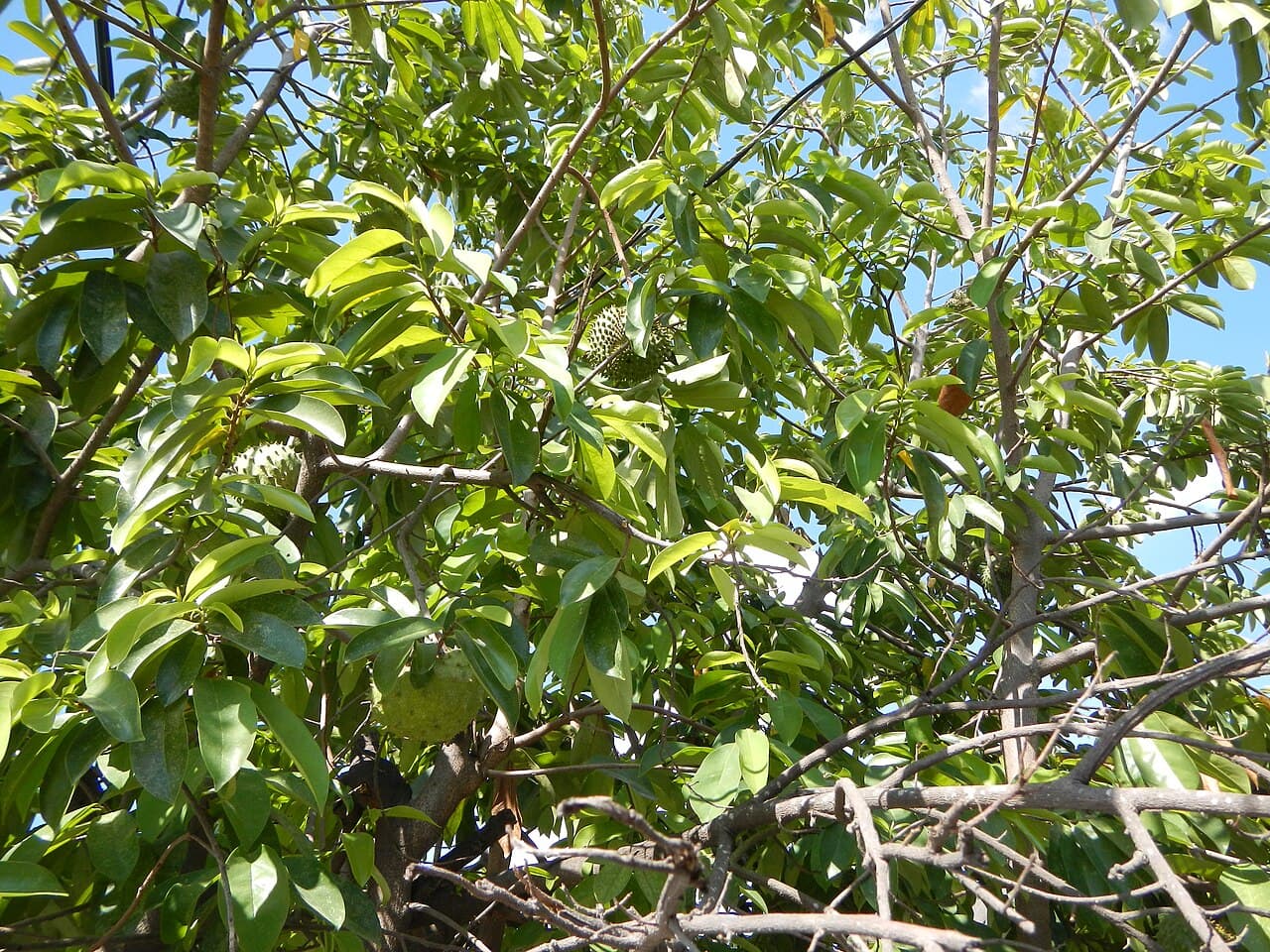
Soursop
Annona muricata
A small evergreen tree native to the tropical Americas, now grown across Nigeria and other tropical regions for its large spiny fruit. The pulp is eaten fresh or juiced, while the leaves and bark are widely used in traditional medicine and have drawn particular scientific interest for their anticancer compounds.
- Category
- Medicinal
- Found in
- West, Central and East AfricaPOWO
- Data sources
- NMPPDB, other literature
Local names
Known in 4 languages across 2 regions
Say it in
Yoruba · West Africa
Ebo
also Apekan
West Africa
East Africa
Spot a wrong name, or know another one?Tell us here ↗
Traditional & Common Uses
Important medical disclaimer
The information below is for educational reference only. It does not constitute medical advice. Always consult a qualified healthcare provider.
- General
Leaf and bark decoctions traditionally used for fevers, malaria, hypertension, pain, respiratory illness, and gastrointestinal disorders such as diarrhea and dysentery.
[1] NMPPDB (nmppdb.com.ng)
- General
Extracts studied for anticancer activity against breast, prostate, and colon cancer cells in lab studies, working by triggering cancer-cell death and slowing cell growth.
[2] Ilango, S. et al. (2022). A review on Annona muricata and its anticancer activity. Cancers, 14(18), 4539.
- General
Leaf and fruit extracts shown to lower blood sugar in diabetic animal models.
[3] Florence, N.T. et al. (2014). Journal of Ethnopharmacology, 151(2), 784–790.
- General
Extracts shown to have antibacterial and antifungal activity in lab studies, supporting traditional use for infections.
[4] Abdel-Rahman, T. et al. (2019). Open Access Macedonian Journal of Medical Sciences, 7(19), 3127.
- General
Extracts shown to protect against gastric ulcers in animal studies.
[5] Moghadamtousi, S.Z. et al. (2014). Drug Design, Development and Therapy, 8, 2099–2111.
Known Phytochemicals
Cautions & Contraindications
- highSignificant risk documented in literature
- high
Annonacin, a compound in soursop, has been linked to neurotoxic effects, and high, sustained consumption has been associated with an atypical form of Parkinsonism in some populations (notably the French West Indies). Excessive intake may also cause low blood pressure and low blood sugar.
[6] Caparros-Lefebvre, D., & Elbaz, A. (1999). Possible relation of atypical parkinsonism in the French West Indies with consumption of tropical plants: A case-control study. The Lancet, 354(9175), 281–286.
Sources & Citations
- 1NMPPDB (nmppdb.com.ng)
- 2Ilango, S. et al. (2022). A review on Annona muricata and its anticancer activity. Cancers, 14(18), 4539.
- 3Florence, N.T. et al. (2014). Journal of Ethnopharmacology, 151(2), 784–790.
- 4Abdel-Rahman, T. et al. (2019). Open Access Macedonian Journal of Medical Sciences, 7(19), 3127.
- 5Moghadamtousi, S.Z. et al. (2014). Drug Design, Development and Therapy, 8, 2099–2111.
- 6Caparros-Lefebvre, D., & Elbaz, A. (1999). Possible relation of atypical parkinsonism in the French West Indies with consumption of tropical plants: A case-control study. The Lancet, 354(9175), 281–286.
- 7Orwa et al. (2009), Agroforestree Database 4.0, World Agroforestry: Annona muricata